DeFi Revolution: Smart Contracts Explained
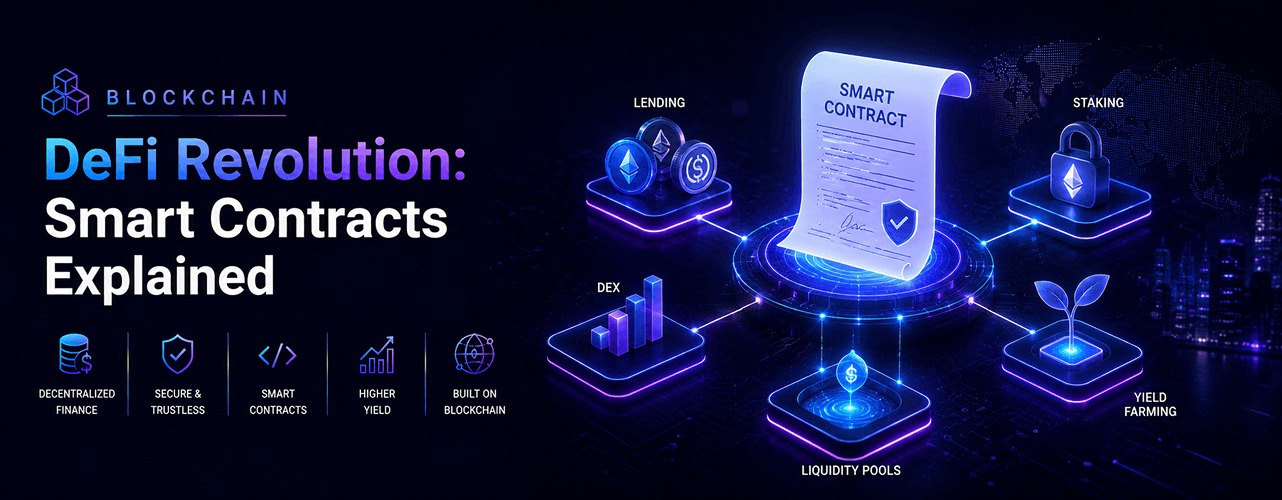
Understanding decentralized finance and how smart contracts are transforming the financial industry.
Decentralized Finance, commonly known as DeFi, is redefining the traditional financial system by enabling transparent, permissionless, and automated transactions powered by blockchain technology.
What is DeFi?
DeFi refers to a financial ecosystem built on blockchain networks that removes intermediaries like banks and brokers. Instead, transactions are executed through decentralized protocols and smart contracts.
This shift enables users to lend, borrow, trade, and invest assets globally without relying on centralized institutions.
How Smart Contracts Work
Smart contracts are self-executing agreements stored on a blockchain. They automatically enforce predefined rules and conditions without requiring manual intervention.
Because they are transparent and immutable, smart contracts reduce operational costs, improve trust, and eliminate many inefficiencies associated with traditional finance.
Key Benefits of DeFi
- Global access to financial services
- Lower transaction and operational costs
- Improved transparency and security
- Automation through programmable contracts
- Faster settlement compared to traditional banking
Challenges Facing DeFi
Despite rapid growth, DeFi faces concerns around scalability, regulatory uncertainty, smart contract vulnerabilities, and market volatility. Security remains one of the most critical considerations for blockchain platforms.
Developers and organizations continue investing heavily in audits, governance models, and layer-two scaling solutions to improve ecosystem stability.
Blockchain technology is transforming finance from a closed system into an open and programmable ecosystem.
— David Park
The Future of Decentralized Finance
As blockchain adoption grows, DeFi platforms are expected to integrate more closely with traditional financial institutions. Hybrid financial systems combining decentralization with regulatory compliance may become increasingly common.
The evolution of Web3 technologies and digital identity solutions will further accelerate the mainstream adoption of decentralized finance.
