
The Future of AI in Enterprise: 2025 and Beyond
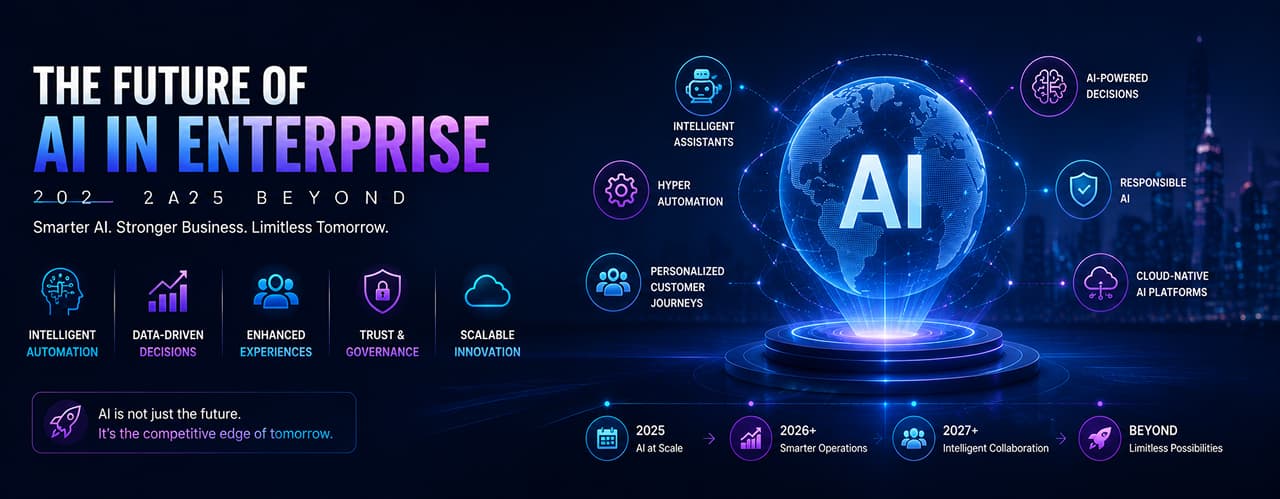
Explore how artificial intelligence is transforming enterprise operations, automation, predictive analytics, and decision-making across industries.
Artificial Intelligence is no longer a futuristic concept — it’s transforming how businesses operate today. From automating routine tasks to providing deep insights through predictive analytics, AI is reshaping the enterprise landscape in unprecedented ways.
The Current State of Enterprise AI
In 2024, we've witnessed a dramatic acceleration in AI adoption across industries. Companies are moving beyond pilot projects and implementing AI at scale. Machine learning models are now embedded in everything from customer service chatbots to supply chain optimization systems.
The key drivers behind this transformation include improved accessibility to AI tools, reduced infrastructure costs through cloud services, and a growing talent pool of AI specialists.
Emerging Trends for 2025
- Generative AI moving from content creation to business process automation
- AI-powered decision support systems becoming standard in enterprise software
- Edge AI enabling real-time processing for IoT and mobile applications
- Ethical AI and governance frameworks gaining regulatory importance
- Multi-modal AI systems combining vision, language, and structured data
Practical Applications
Leading enterprises are leveraging AI in innovative ways. Retailers use computer vision for inventory management, financial institutions employ NLP for fraud detection, and manufacturers implement predictive maintenance to reduce downtime.
The ROI is clear: companies report 30–40% efficiency gains in AI-augmented workflows.
AI is not about replacing humans — it’s about augmenting human capabilities and freeing us to focus on creative, strategic work.
— Dr. Andrew Hale
Challenges and Considerations
Despite the tremendous potential, enterprises face several challenges: data quality and availability, integration with legacy systems, skill gaps in AI implementation, and concerns around bias and fairness.
Successful AI adoption requires a holistic approach addressing technology, people, and processes.
The Road Ahead
As we look toward 2025 and beyond, AI will become increasingly democratized. Low-code AI platforms will enable business users to build custom models, while AutoML will streamline the development process.
Organizations that invest in AI infrastructure, cultivate AI literacy across their workforce, and establish robust governance frameworks will be best positioned to thrive in this new era.
